The pursuit of truth is a profession
Serious MenThe pursuit of truth is a profession is Ayyan Mani’s unsentimental account of scientific life: the search for ultimate answers may be earnest, but it is also work, performed by people who must spend their days doing something. At the Institute of Theory and Research, this thought cuts across a grand vocation and its ordinary machinery—debates, publications, money, and institutional rivalries. Ayyan dismisses the promise of final truth, yet his criticism is sharpened by the fact that he wants his son, Aditya Mani, to enter the world from which he himself feels excluded.
A vocation made ordinary
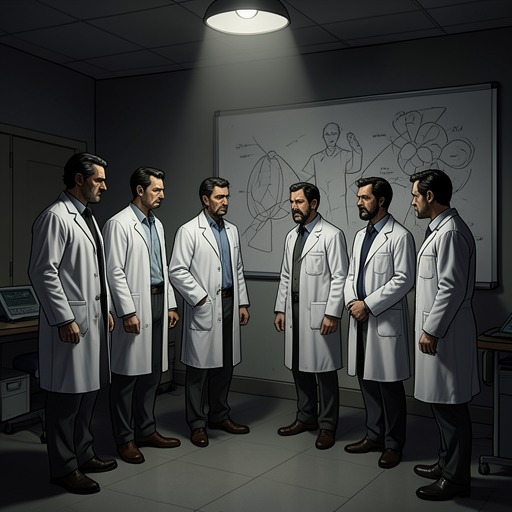
The Institute’s setting gives scientific work an almost secluded grandeur. Its ten acres of lawns, ancient trees, angular central building, black boulders, and sea form a sanctuary for people absorbed by questions about the universe. Some discuss lithium, the speed of light, or the weakness of gravity; even the question of whether to capitalize the word universe can become a matter of debate. The scale of the setting and the scale of the questions seem to promise a life set apart from ordinary concerns.
Ayyan sees the performance within that ideal. After thirteen years, he can no longer bear the scientists’ exalted manner: they spend public money and then announce that humanity knows nothing, while presenting their profession as a uniquely elevated form of thought. Their public claims of intellectual purpose sit beside their concern with citations and the pressure to publish. The Institute may be a sanctuary for inquiry, but it is also a workplace whose members measure recognition and count cash. Ayyan’s point is not simply that scientists are insincere; it is that intellectual grandeur does not remove them from the practical incentives and routines shared by other workers.
The endlessness of the search
At the monthly gathering of scientists, Ayyan watches the search for knowledge move through a sequence of small and immense subjects. The company debates how to cut a cake efficiently, mocks a claim about predicting the highest prime number, and turns to the Large Hadron Collider near Geneva. To him, such shifts reveal the unending character of inquiry. The scientists have not produced a final explanation of why life exists or why there is something rather than nothing; unlike religious sages and mendicants, they do not offer a fable that closes the question. Their work continues because the answer remains out of reach.
Ayyan consequently treats the pursuit itself as the occupation. He once explains this to Oja Mani by contrasting Einstein’s work on relativity with her scrubbing the floor twice a day. The contrast is deliberately irreverent: the scientist’s celebrated theory and the household chore are different kinds of labor, but both occupy a person’s time. For Ayyan, the persistence of the search does not prove that science will arrive at final truth. It shows that people keep working at questions that cannot be settled once and for all. The formulation lowers scientific vocation to employment, but it also makes the activity’s endurance intelligible: the search goes on because it is what its practitioners do.
Who gets to define science
The Institute’s argument over the Giant Ear makes the professional stakes of that outlook concrete. Jana Nambodri urges Arvind Acharya to let radio astronomers use the instrument to search for alien signals. Requests have arrived from astronomers around the world, other scientists at the Institute oppose the ban, and universities are offering substantial usage fees. Acharya refuses, calling the proposed search nonsense and insisting that the Institute is not motivated by money. The dispute is therefore about more than an instrument’s schedule: it concerns who may decide which questions deserve the Institute’s resources and the authority of the word science.
Acharya argues that the search for extraterrestrial intelligence repeats an earlier mistake in robotics: people imagine other forms of intelligence in their own image. In his view, scientists seeking radio signals are searching for beings sufficiently like humans to build machines and communicate as humans might. He interprets that hope as a response to loneliness, not as science, and adds that publicity attracts researchers to the search. Nambodri’s answer rests on a different standard. Even a very small mathematical possibility, he argues, can justify a search for truth; hope is essential to scientific work. Acharya’s bitter retort—that hope is a lapse in concentration—turns a methodological disagreement into a conflict over what intellectual discipline should permit.
The challenge becomes public within the Institute when Nambodri tells the gathered scientists that the Balloon Mission is not the only work that matters. He says many, especially the radio astronomers, regard Acharya’s refusal to permit SETI on the Giant Ear as autocratic and unfair. Their confrontation exposes how scientific categories can distribute power: a project called nonsense can be denied access to an instrument, while its advocates appeal to possibility, research demand, and institutional fairness.
Work, status, and aspiration
Ayyan’s criticism extends beyond the Institute. After listening to a conversation about the Balloon Mission, he thinks about the variety of jobs performed in the world outside: people sell products, handle investments, write and rewrite newspaper articles, take photographs, and appear on camera. These occupations seem no less peculiar to him than searching the atmosphere for microbes or studying bottles of air. The scientists’ work is not uniquely strange; it is one instance of the many ways people make a living.
Yet Ayyan does not stand outside this system without desire. He imagines that he and Oja might have lived in a building with a lift and entered restaurants without being unsettled by their cold air, unfamiliar fish names, and mild spices. The ease of belonging to the prosperous world appears to him less a reward for individual merit than a consequence of being born into the right homes. He also imagines Adi among those people one day. The irony is central: Ayyan mocks the prestige attached to scientific and professional life, while wanting his son to possess the security and status that life represents. His idea of truth as employment is therefore both a judgment on the Institute and a measure of the social distance he hopes Adi can cross.
A practical standard of evidence
The later account of the high-altitude discovery complicates any simple division between scientific work and unsupported hope. Asked why he thinks living matter came from space, Acharya says he has not reached a conclusion; he calls it a reasonable guess supported by facts. Bacteria and fungi were not believed to exist at such heights, while contamination from debris of defunct satellites seemed very unlikely. He also points to the rarity of the bacteria and fungus and the difficulty of culturing them in a laboratory.
That distinction—between a conclusion and a supported guess—shows the Institute’s work operating through evidence, not merely through professional routine. It does not resolve Ayyan’s larger skepticism, nor does it erase the struggles over authority and funding. Instead, it leaves the expression’s central tension intact: scientific inquiry can be a job shaped by institutions and ambition, while still requiring people to distinguish what they know from what they consider plausible. Ayyan sees no final truth waiting at the end of that labor. What he sees, and what the novel repeatedly stages, is the labor itself.